Thursday, 23 May 2019

Lights in the Dark.

A peaceful night in Horseshoe Bay.

The Nazaré Project and work on the Anna M remain stalled for the want of funds. We will embark on a political effort to obtain funding once the new European Parliament is in place. Meanwhile, the weather is great in Sherkin, and at least I have been glad of the chance to put in some solid Spring work on our biteen of land, for the first time in some years, since I have been distracted by the crisis with the Anna M and also the business of building the West Room. Today is wet, and I am back to blogging. Coming up shortly is our John's wedding with Andreea in Rumania, and then we have an invasion of grandchildren, so it will be July by the time I get to work again on the boat.

     My old mind does keep ticking away in the background, even while I am barrowing out manure or whatever. I bear in mind one of the amazing bits of wisdom that Pope Francis throws out:-  'An authentic humanity, calling for a new synthesis, seems to dwell in the midst of our technological culture, almost unnoticed, like a mist seeping gently beneath a closed door.' What is this 'new synthesis'? Can it possibly 'seep' fast enough to save us from this same 'technological culture'? 

     The Pope speaks of the need to find a renewed 'enchantment' with nature and physical reality, to fall in love with the world again, if we are to find the necessary spiritual strength to confront the environmental and political emergencies of our time. But how often have Christians taken the line that 'the world' is a lost cause, a write-off, even if we are told that Jesus came to save it? It is not after all entirely unreasonable to regard the world as disposable; a bit like a booster rocket that falls away as we attain our immortal destiny in Heaven.

     So much depends on our personal and cultural situation. Basically things have been fairly ok for my generation in the affluent West, in spite of many 'dangers, toils and snares'. Faith in Progress, supremely a child of 19th century English and American bourgeoisie, carried people along with the sense that things were getting better and enabled confidence in a benign deity. Things looked darker from the point of view of people who for instance were starving in Ireland, whose God, if he was good at all, was darned hard to find in this world.  Hence the 'unhealthy dualism which left a mark on certain Christian thinkers in the course of history and disfigured the Gospel'. 'Jesus was far removed from philosophies which despised the body, matter and the things of this world',  insists the Pope.

     St Augustine comes to mind, living as he did in the twilight of Roman civilisation. There was a great travelling Irishman, Pelagius by name, who made the perilous journey to North Africa to debate such matters with him. The 'Celtic' Christian tradition that Pelagius came from tends to be celebrated these days for its rootedness in druidic sun worship, love of nature and independence (read, freedom from Roman dogma). But the Protestant Reformation, when it finally came many years later, was equally mistrusting of Mother Nature as St Augustine, and to judge by the subsequent course of English and American civilisation, probably yet more prone to treat her as a foreign city to be ransacked or enslaved. Oh yes, then there's that Patriarchy business again, but I shall leave the matter of the crying need for a new 'gender balance' for another day!

     The German Romantic poet Goethe bemoaned his alienation from certain 'worthy Christian souls, in a manner in which the Church has more than once fallen into dissension - One part maintained human nature has been so far corrupted by the fall of man, that to its innermost core not the least trace of good was to be found in it; therefore, man must renounce his own powers altogether and expect everything from grace and its influence. The other part very willingly admitted the hereditary defects of mankind, but wished to attribute to nature a certain inward germ which, animated by divine favour, was able to grow up to a joyous tree of spiritual happiness.'Here then is a key element of the dualism that we have to overcome. But would Goethe have been able to sustain such optimism through the subsequent history of his country?

      Today our prospects are apparently appalling, and the future obscured in the darkest of storm clouds. At the same time, if the challenges are overcome, there are some truly wonderful possibilities. But conservatives may well object that the 'spirit of Progress', which is invoked for our salvation by 'progressives' in spite of the many ecological sins committed in its name (big industrial fishing trawlers, thinks I) tends to rely on an overly optimistic estimate of the power of merely human reason and a romantic hope for unredeemed human nature. To have any hope of a generalised 'ecological conversion', we need to be ready to make huge efforts and indeed sacrifices. We need all the spiritual resources we can muster, such as access to forgiveness so that we may recognise our sins. We need also to believe this whole shebang is actually going somewhere.

     Enter the great catholic apostle of progress, Teilhard de Chardin. With Pope Francis, he is at last achieving a degree of official recognition. He offered a narrative that reconciled 'progress and science' with 'religious truth'. We may say that he was building on St Paul's letter to the Romans - 'The whole creation is eagerly waiting for God to reveal his sons.... From the beginning till now the entire creation has been groaning in one great act of giving birth.'  The great objection to Teilhard was that he down-played, or indeed had no place for, the doctrine of Original Sin, just as progressives today often seem to downplay the reality of human egotism. Nonetheless, he stood behind such great figures of the Second Vatican Council as Henri de Lubac, which Council is only with the present pope possibly reaching fullfillment, to the consternation of some of a conservative mindset. Secular thinkers tend to dismiss such theological controversies as 'dancing on the head of a pin' etc. In fact they go to the heart of our human dilemma, as they tear through human history, taking many different forms; but, despite its popularity these days, it is hard to believe that the narrative of a great confrontation between 'progressives' versus 'fascists/populists/neo-liberals etc' will get us anywhere good! We should certainly beware of any facile idea of a rerun of the narrative of the 1930s, or any other narrative, for that matter. 

     The Community of St Gregory, named for the great 'romanizing' pope of the sixth century who had some trouble with among others the 'wild Irish' missionaries of the time, was rent asunder around the time I left their care at Downside in 1965. The community had a history of tension between those who wanted to be 'real contemplative monks' and the demands of mission, the school and so on. Some say it reflects the difference between St John, the mystic, and St Peter, the shepherd or catcher of men. I ended up heading for Glencolmcille, in some little way under the inspiration of St Columba. I too was seeking 'a new synthesis'. I very much agree with the Pope that 'the absence of synthesis today is everywhere, especially in the political world. It results in incoherence in policies at every level and ineffective action.' Is it too much to hope that the time for a new, organic and coherent civilisation is indeed coming round at last? It would badly need to, but just what form it might take remains as inscrutable as Yeats' 'rough beast, slouching toward Bethlehem to be born'!

*Quoted by Jacob Streit in Sun and Cross, a good read for those interested in 'Megalithic Culture and early Christianity in Ireland'.

Quotes from Pope Francis' encyclical 'Laudato Si'', via 'An Irish Response' published by Veritas and available at:- https://columbans.ie/shop/


Saturday, 4 May 2019

On Bird-song and Flower Power, Starlight and Simulacra..

The sound of bird-song coming into our bedroom early on a May morning, a sky-full of stars on a clear night with Jupiter casting a shining track on a calm sea, butterflies flitting in the garden, wild flowers blooming on all sides, only the
Bluebells by Fiona.
occasional vehicle to disturb the peace and belch forth noxious fumes as you walk along the roads - such are the joys that sustain us in our island home, and more than compensate for a lack of the 'joys of civilisation', that sadly often constitute so many ways of contributing to the multiple catastrophes that are engulfing our beautiful world. Yet how might it be possible to so turn the situation around that the joys of nature could become once more the normal human patrimony, rather than the privilege of an increasingly beleaguered minority?


The BBC brings us* the happy tidings that the British Committee on Climate Change (CCC) maintains this can be done at no added cost from previous estimates. If other countries follow the UK, there’s a 50-50 chance of staying below the recommended 1.5C temperature rise by 2100.' Brilliant news indeed! We have a 50-50 chance of avoiding outright catastrophe, if other countries follow the UK! That's a good one, considering the UK is doing all it can to withdraw from constructive cooperation with its neighbours, who at least happen to be a small bit more switched on than the relative from across the ocean whom they are about to welcome to their shores (and may he be welcomed with huge climate and proEU demos). 

If the EU were not distracted by the Brexit folly and mesmerized by the emergeance of the 'Far Right' across Europe, we might all be getting around to a sane and humane policy with regard to both the climate and the migration crisis. I mean, for instance, a kind of Marshal Plan for North Africa, aimed at creating employment there and producing hydrogen from all that sunshine in the deserts. It seems to me that the missing ingredient for the transition to electric power, practically speaking, remains the production and distribution of hydrogen, especially for fuel cells, because lithium batteries and the current means of generating electricity will not hack it by themselves.

Said the lead author of the CCC report, a Mr Stark, to the Beeb - “This report would have been absolutely inconceivable just a few years ago. People would have laughed us out of court for suggesting that the target could be so high.” Meanwhile Aunty Beeb herself goes on her sweet 'even-handed' way - 'Some say the proposed 2050 target for near-zero emissions is too soft, but others will fear the goal could damage the UK's economy.'  So much for this brave attempt to face stark reality!

At this stage I must quote extensively from Tom Jackson's** Babbling of Green Fields, since he puts the matter so very well:- 'What do human beings generally do when they are faced with a challenge they know that they must meet but nevertheless do not wish to do so? They rarely say 'oh blow it, I'm going to enjoy myself and hang the consequences'. Such indulgences of clear-sighted moral responsibility are reserved for only small crimes. Faced with great ones, they generally avoid the issue by inventing simulacra that give the impression that the issue is being dealt with when in fact it is not, and the more grand ceremony and trumpet blowing with which the simulacrum is launched the better it fulfils its function. The climate agreement reached in Paris in December 2015 is, I fear, just such a masterpiece of moral evasion. Even the UK, among the more responsible countries, is far behind on its commitments (in July 2018). The very next day after the politicians returned home from Paris full of self-congratulation, Amber Rudd, then under-secretary for the environment, announced that subsidies for renewable fuels would be cut while those for fossil fuels would be maintained. 2017 was the worst year yet for carbon emissions and 2018 has been worse.'
Violets by Fiona.

But what then are we to do about it? How are we to cope? Being overcome with anxiety and despair, or carried away by anger, are neither of them going to do any good. It is worth recalling that human life has always existed on a knife-edge,  subject to all kinds of disasters. If we are now faced with a more total and all-consuming kind of multiple catastrophe than has ever been known before, we are also gifted with the means to avert it, and a level of awareness unheard of in the past. If only we can somehow find the will and way to rise to this challenge, the possibility of a whole new and magnificent  era for humanity beckons. Never have the stakes been so astronomically high, and it is a wonderful privilege to be alive in these times. Immense responsibility falls to those who glimpse this to spread the word, to communicate it and inspire others to do so.


How might we do this? We must start by admitting the reality, and then changing our lives as best we possibly can: - working at ameliorating the situation in any way we can, while always seeking truth and avoiding those deceptive simulacra, into which indeed our entire political and economic set-up is in danger of deteriorating; - learning to really appreciate that wealth does not buy happiness and there is indeed a kind of poverty which truly enriches, while the notion that any kind of well-being can endure, economic or otherwisewhile we continue to decline to acknowledge the damage that we are inflicting on the natural world upon which it all depends, is utterly absurd. Enjoy and cherish those wild flowers and butterflies, that birdsong, the soft star-light on the sea, and above these, the company of those with whom we are gifted to share them!
Flowers on the Rocks by Joe.

**http://thomj.co.uk/
*https://www.bbc.com/news/science-environment-48122911

Saturday, 27 April 2019

Fly Away Ladybird.....

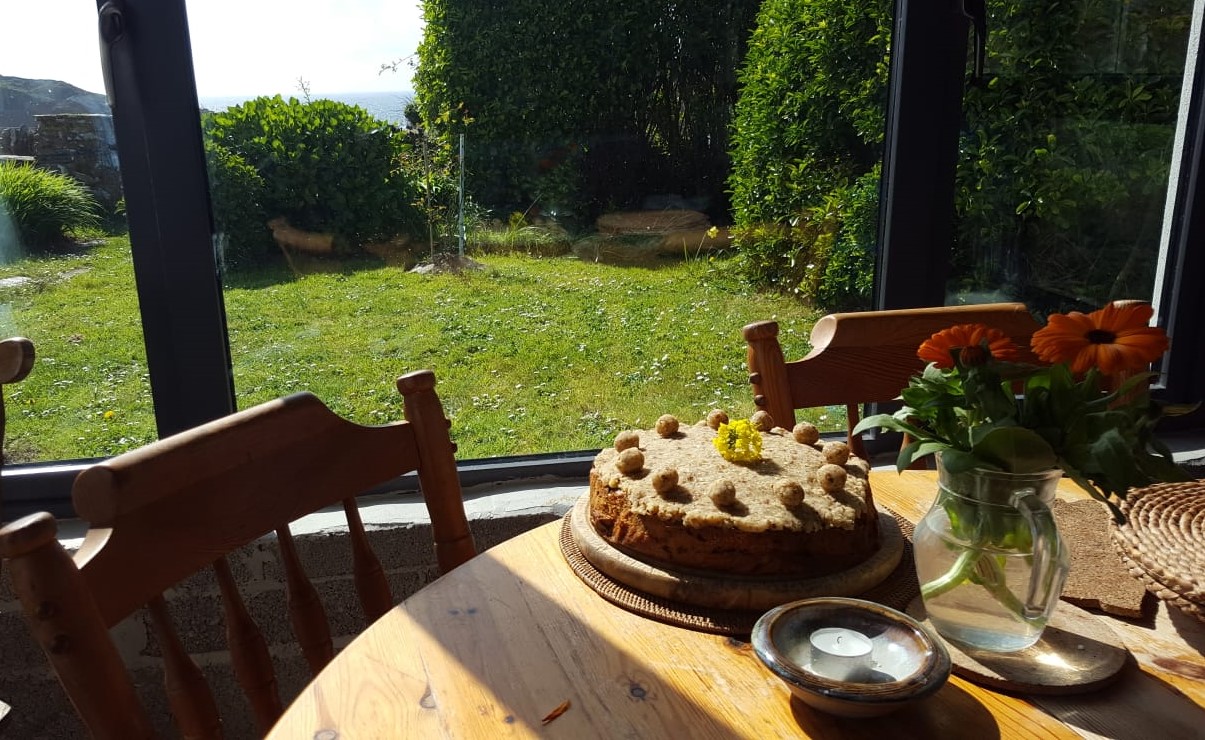
Simnel cake.

Fly away ladybird, your house is on fire.... What is this 'ladybird', and how could her 'house be on fire'? Yet what a memorable jingle it is - it must hit some mysterious chord. Personally, I associate it with childhood bliss and also life in the womb - my own Garden of Eden - that fleeting treasure, that as we grow up, life seems bent on destroying. The Dragon awaits to devour the child - see Chapter 12 of the Book of Revelation - even while, if we are fortunate, our experience of bliss expands to that of Nature, even to ladybirds and so on. If we are unfortunate, we are torn to pieces and expelled from our mother's womb before we are born, or perhaps we find no love to welcome us into this world - very shocking thoughts for those of us who cherish 'the bliss'. But we ourselves connive at our own exile, being embarrassed by those dim, subliminal recollections of bliss in the womb and the arms of our mother, even afraid of the vulnerability they betray, as we are determined to assert our own autonomy. We may well be pleased with ourselves for having thus established our individual viability - and yet, deep down, how we miss that bliss! So on we go to seek to retrieve it in the arms of a lover.

     Indeed I count myself most fortunate in that, having done so with Fiona when she was seventeen, here we are still doing so in our seventies, in spite of those times when, with the world weighing on us, the upwelling spring all but dried up. You may say this is just a matter of luck, but I am sure there would be no such luck, had we not somehow managed to root our personal bliss beside that upwelling spring. In fact doing so is surely the principal business of our lives. To succeed, we need to recognise that it is more than a mere idea or some impersonal force. As it happened, Fiona was greatly aided in setting out with me by a mystical experience of Our Lady's presence in the Lady Chapel of the cathedral of Notre Dame, no less.*

     Abstractions, or even cathedrals, are incapable of sustaining bliss in the absence of faith; we need to become worshippers rather than tourists. Yet we must seek understanding and employ structures also. Primitive people found spirits within their springs, trees, mountains, seas, everything. Eventually it dawned that behind the multiplicity, there was unity, and in the end, personal bliss is a matter of union, of grounding in a single cosmic reality. More, it is a matter of being drawn into relationship, which nothing less than personal love can deliver. This process culminated, for the plain people of Europe and many other places beyond, in identifying the 'well-spring of bliss' with Mary, 'Queen of the Angels, Queen of Heaven and Earth', while their special places were dedicated so frequently to her - Notre Dame de Paris, Nossa Senhora da Nazaré etc,etc.

     The penny only dropped with me lately how her name, Mary, may be identified with the sea; certainly it is reminiscent of the Latin mare and its modern derivitives like mer and mar. St Jerome and St Bernard of Clairvaux at least thought it meant Star of the Sea. A little research (a dangerous thing) tells of connotations of 'beloved' and also 'bitter'. Well the sea, as well as being in a sense the womb of life on Earth, has notes of universal love as well as of bitterness too, but of course so has love itself, it being ever threatened by 'the Dragon'. For me, Mary is 'bliss' personified, and indeed it was my own mother's name, while her sister, on becoming a Carmelite, took the religious name 'Sister Mary of the Resurrection'.

     Even while my father had so luckily been sent to England on a gas course, where he and my mother conceived a baby whom they named Joy, his fellow officers in the Royal Warwickshire Regiment, out of ammunition in the rearguard of Dunkirk, were as he later discovered being massacred by the SS in France. He proceeded in subsequent years to fire words at the religion of my mother and aunt that, one might surmise, in some sense echoed the thought of the bullets and hand grenades tearing into the flesh of his comrades. He would undoubtedly have loved to share that female 'dream' of bliss, but he could not bring himself to do so. No doubt I was far from unique in growing up trying to reconcile the horror of so much of reality with the dream of bliss, but I was, if that is the right word, blessed in hearing the conflict so articulated.
     
     It didn't stop at home, as you may find out by delving into the despatches From the Fractal Frontier  in this blog. Suffice here to say that I finally became convinced that, besides being indispensible for humans to flourish, it is far from irrational to believe that God loves us, and to accept the idea that He should hang his plan to rescue the human race on the slender thread of a humble young woman's consent.  'The Angel of the Lord declared unto Mary....' The whole of creation was hushed, teetering on the brink, as it strained to hear the quiet voice say: 'Behold the handmaid of the Lord, be it done unto me according to thy word.' For all her humility, she nonetheless announced:-

Yes, from this day forward all generations will call me    blessed,
for the Almighty has done great things for me.
Holy is his name,
and his mercy reaches from age to age for those who fear  him.
He has shown the power of his arm,
he has routed the proud of heart.
He has pulled down princes from their thrones, and exalted the lowly.
The hungry he has filled with good things, the rich sent empty away.

     So it was that the 'wild imaginings' of a young Jewish woman became the well-spring of so much art and beauty, one might say of European civilisation and much more. From beautiful churches throughout the continent, at noon and eventide every day, the Angelus bell rang out and work stopped while the people recalled the great mystery. The novel ideas of freedom, of a world not ruled by violence and strength, of power being conditional upon consent, were loosed upon the people. The memory of that 'lowly handmaid' forever confronted the cult of violence, which reached an apotheosis in the 20th century. Subsequently, by some amazing quirk, the European Union found the inspiration to put Our Lady's crown on its flag - as St John wrote in the Book of Revelation, 'a great sign appeared in Heaven: a woman, adorned with the sun, standing on the moon, and with the twelve stars on her head for a crown....'

     St John warned , 'for you, earth and sea, trouble is coming - because the devil has gone down to you in a rage, knowing that his days are numbered.' One would have thought that the great warnings of the 20th century should have sufficed to wake us up - but no, and now there are more. But even Science seems to be getting there - what with new insights about for instance climate change, life in the womb, quantum physics...! Will humanity find the strength and will to rise to the challenge? I find it hard to believe that we will do so until we learn to say again together:- Hail Mary.... 


Our brave Easter lily....
...confronts its dragon.


*Fiona writes:- I was in Paris for several weeks, at the age of 18 in the summer of 1966. I loved the feel and smell of the ancient churches and sometimes went to Mass, and was moved by the realisation that this same catholic Mass was being celebrated throughout Europe and to the far corners of the world, as it had been for the last two thousand years. I had been struggling with the idea of becoming a Catholic since I was fourteen.


     One time in Notre Dame, I came by the Lady Chapel. As I stood there the statue of the Virgin and the whole chapel was filled with radiant, golden light, in which I felt myself enveloped in her arms. I felt intimately the warmth her presence, and I knew then that I would become a Catholic and that she would show me the way onward. That vision has always stayed with me, and I realised when I visited again years later, and found the space quite normal, that I had indeed been blessed with a visitation by our blessed mother. 

Sunday, 14 April 2019

An Easter Dream

Palm Sunday.
So that's the end of another Act in the Brexit Saga! Here I am in Alcobaça, Portugal, and most English people I come across dearly want to tune out. 'Why can't they just get it over with, so we know where we stand?' Well tomorrow I'll be back in Ireland, which brings to mind just one of the reasons why 'they' cannot do any such thing. Brexit has laid bare the bankruptcy of the present set-up, particularly in the North - a compromise that has fallen at the test.  The breakdown of the devolved power-sharing executive and the threat of a return to violence that this implies just might have figured more in the headlines, if the world was less fixated on the carry-on in Westminster.

     What else might the headlines have been about? Climate change, the millions suffering from environmental degradation, hunger and violence, or nuclear proliferation, trade wars, democracy under threat all over the place including the U.S.A., the world awash with money that doesn't know where to go while the poor are falling back? Perhaps, but most people would rather tune out that lot too, and it's hard to blame them!  

     In fact of course all this and the Brexit saga are interconnected.  In the face of chaos and impending doom, there is a very natural inclination to pull up the draw-bridge and dig in behind 'old certainties'. Prime Minister May and her Chancellor, Philip Hammond, the dude with a po face who generally appears  behind her at the despatch box in the House of Commons, keep on about the 'bright future' that beckons if only they would pass her deal - a reunited country, its ancient liberties and place in the world reasserted, will at last be able to resume the march to ever greater prosperity etc. Who are they trying to kid? A realistic appraisal of the fraught situation in this ever more interconnected world means that Britain will either be drawn into  even greater integration with the rest of Europe, or become something of 'an overseas territory' of the U.S.A..

     Ireland suffers from the same dichotomy, complicated by the relationship with Britain and much exacerbated by The Duckie. I know too well that it is a lot easier to cross the Irish Sea than the Bay of Biscay, or even the 'Western Approaches' to France - otherwise, history may well have been different. Yet they are all a lot easier than crossing the Atlantic. Meanwhile, the two island economies are pretty much 'joined at the hip'. There is no way that Ireland's relationship with Europe can thrive by trying to pretend that this reality can be totally overturned, much as I for one would sometimes rather like to. There will be no easy resolution of this situation.

     'Never let a good crisis go to waste!' This might be a much more fruitful way to look at things, though I don't suggest it will be easy. I have taken the line, for most of my life, that if the world wants to go to Hell, there's precious little I can do about it. The best thing is to do my thing as well as I can and leave the rest to God. However, the nearer I get to leaving this world, the more I am inclined to love it, to dream dreams of a future for my grandchildren, and to remember that I shall be called to account for what I have done or failed to do, or even have said or failed to say. Talking about things (not just chattering) is after all the first necessity if anything effective is to be done about them, and when people cop out of the challenge of doing so, because they find it difficult or uncomfortable, they are on the way to paralysis and break-down.

     So what of my dreams? They are likely to be rather different to those of Prime Minister May and Chancellor Hammond! I have criticised their Brexit project from the start as an unrealistic fantasy, though not as whacky as that of the likes of Mr Boris Johnson. Hadn't I better set down my own little notions? I will try, and I would have allowed that they too are probably unrealistic, were it not for the little fact that it is impossible to visualise a realistic future at all if we persist in trying to stick to 'business as usual' much longer.

     In England a prerequisite for real progress is to finally leave behind the dream of Empire. Interestingly, this is by no means a problem confined to Great Britain.* The European project is so important largely because it seeks to realise a new paradigm for the relationships between and within the nations, which is why the likes of the Brexiteers, The Duckie and President Putin dislike it so much.  But how could England finally sign up for this project, maybe even leading the way for the renewal of the EU?

     Perhaps one good starting point would be to dispense with the monarchy. It could be done quite gently. Let Queen Elizabeth live out her reign, and meanwhile consult with Prince Charles, who after all gives the impression that he doesn't have that much ambition to be King. He would actually make a pretty good chairman for the establishment of a new set-up, some kind of confederation of independent republics. Indeed he might relish active involvement, rather than being called upon as another stuffed shirt. Perhaps the President might be appointed, not without reference to the demos, but in some other way than universal suffrage, possibly by the House of Lords, along the lines of the method by which the Pope is chosen. After all the papacy is the institution that has endured the longest, and there is an example of the gentle deconstruction of an imperialistic set-up! In fact the heir to the throne might sit in that Upper House, along with some other heriditary members and other representatives of society. There is something to be said for having some there who owe nothing to any political patron, nor constituency of voters, but who are trained from youth to think about the big picture and also to cherish unpopular minorities and truths. 

     The new British dispensation could even be a trial run for a European confederation. Part of it would have to involve strong but inter-related levels of subsidiarity, actively involving as many people as possible in local and regional democracy, that anyone could participate in and wherein their representation worked from one level to the next. The achievement of such active and widespread collaboration should be one of our highest social aspirations - a new kind of sport, rather better than gawking at football on the tele, and more important than most 'work' too! 

     Just how this is to be worked out would involve regional assemblies, preferably going beyond the five nations (England, Ireland, Scotland, Wales and the Channel Islands, probably with Mann), to perhaps the four provinces of Ireland and a similar breakdown of England - Wessex, Essex, Northumbria etc. A similar reconstruction of France and Spain would also be good, so that Brittany, the Basque country, Galicia, Catalonia etc would also find their voices in more than name.  In the other direction, let's have a Council of the Atlantic seaboard nations, from Norway to Portugal. One could envisage some four such mega-regions in the EU. In this way, the European project would shed its remote, Napoleonic aspect, and a much more hands-on, immediate and dynamic kind of democracy could be applied both to the development and integration of Europe and to the immense global challenges of the Great Transition to a sustainable future. 
     
     It could be fun. Happy Easter!

Alcobaça Mosteiro.

  *https://www.theguardian.com/commentisfree/2018/dec/10/nostalgia-for-empires-lost-seductive-dangerous   

I'll be taking an Easter break from this blog too, and hoping there will be stronger progress on the 'sailing' side of things when I resume. At this point the 'Anna M' is slowly acquiring new steel floors, which hold the hull and keel together.

Saturday, 6 April 2019

Citizens of Europe, Indeed!


When institutions that we love and admire, or even those that we merely take for granted while they shape our lives, suddenly crack and reveal themselves as dysfunctional or plain inane - be they families, political parties or whatever - when such events occur, there is naturally a profound sense of shock and dismay. Moreover, there is inclined to be a nasty 'domino effect', a collective nervous breakdown, though of course it is a crisis of individuals too. Such an effect seems to have broken out with particular virulence in England just now.

     Perhaps the best way of describing it is as a crisis of meaning; and it really does seem to have taken this long for the collapse of the British Empire to sink into the collective psyche there. This is by no means all there is to it - plenty of other places in the world are suffering an even more extreme version of it. The collapse of marriage and the family, and of the sexual mores that (more or less) prevailed when I was a child in the 1950s, seems to have some kind of mysterious relationship with it, something to do with the absence of a shared context of meaning undermining the foundation of a marriage, household and family, and also, paradoxically, one's very relationship with physical reality.

     The net effect anyway is for paralysis and disintegration to set in. Many of our contemporaries will try to account for it in economic terms. I would argue that, for all their importance, the economic effects are secondary. Human beings are rational animals, and human life simply does not work when deprived of a more or less viable spiritual and ontological context. If anyone cares to delve into earlier posts of this blog, they will find my account of a kind of collective nervous breakdown, though particularly in an individual monk, that affected Downside where I went to school, back in the 1960s. This launched me into the world with the sense of an approaching apocalypse.

     The world has lurched on since - our European part of it in relatively good health on the whole - but it has to be said that is not saying much. With the Lord, a thousand years is like a day, said St Peter, so on that basis we may think in terms of an hour since the 1960s. In conventional terms, it might be said that my life was spoiled, in that it became psychologically impossible to undertake the kind of career for which I was educated, and besides, if you kick the System in the teeth, you are rarely forgiven. Perhaps indeed my life had been a wilderness, unblessed by Fortune's smile, had Fiona not left her highland home and ventured forth with me! The fact is, difficult as our lives have at times been, we've had a great time and been looked after by a kind Providence whenever the chips were down.

     I suppose this is the reason why, while many people are getting upset, angry, depressed etc, and while indeed I too am not immune to such feelings, they do not really get to me. On the contrary, I am much more inclined to look for the potential human development that I hope to see come of it all, in spite of all the negativity. Alright, I have to admit it, in a sense I find it exhilarating and am thriving on it all; after all, isn't this process of drawing life through death what our Christian faith is all about? I'm very glad that I bailed out of Blighty when I did though, back in 1973. I can 
now, from a semi-detached position, afford to admit  that I find the present situation intellectually stimulating!

     Meanwhile, I recognise that it does take its destructive toll, even on our own little Nazaré Project. At least this prevents me from getting smug. Alec's initial application to Portugal 2020 for funding has been refused, and it is proving very hard to maintain momentum on the renovation of the Anna MPerhaps what we need is a spot of Islamic Finance!* It really is sobering to realise how absurdly difficult it is to get a little enterprise going in contemporary Western society, even if it fits all the fine talk about financing the transition to a sustainable economy. 

     We are suffering at first hand the disconnect between what is promised and what is delivered. Why is the sort of thing that seems obvious, that there is a crying need to mobilise small businesses and enterprises in undertaking that Transition - why is it so very difficult? Really people all have the same basic needs - a living wage with a bit of dignity at work and joy at home - and when you think about it, even the political right and left hardly disagree about such things. Why then is it so difficult to deliver them?

     Sometimes it seems to me that the whole Left/Right business is but a case of distracting and dividing the mass of people, keeping them down. Certainly they look very similar, and nasty, at the political extremes. Closer to the Centre, is there much difference in fact, other than perhaps greater emphasis either on social effort to the left or on individual responsibilty to the right, both of which are manifestly necessary? But if it is a case of the people being deliberately kept down, one cannot but ask what are these dark forces? Perhaps it's enough to say that money may be a good and useful servant, but is a very bad master - which will rule us if we let it. 


     Instead of taking off into speculation, I'll try my hand at a bit of play-acting, recounting a meeting where a few contemporary pols meet in a London pub. Major Wheeze-Flogge's daughter, apparently, has just received her new British passport with the offending words European Union removed from the cover.** Larrie Larookar was visiting his native London, though nowadays he has a teashop over in Dublin.

Major Wheeze-Flogge :- 'Citizens of Europe' indeed! The young people these days seem to think they are entitled to go on the gad all over the Continent, instead of knuckling down to stacking supermarket shelves or picking cauliflowers. Damn lucky to have the work! Too much education is the problem. All the third level education they need is a couple of years in the army. Too bad for the army, mind you. I’ll give them ‘citizens of Europe’! Downright treason, I call it. Whatever happened to those Subjects of Her Majesty the Queen, anyway?

Larrie Larookar:- 'Struth, I saw a crowd of them on a trip-boat in Ibiza once, all drunk and roaring Rule Britannia. You're quite right, they really shouldn't be let out at all! But do you think we could all survive together shut up in our little islands, only let out on the odd coach tour as a golden oldie? And anyway, what about those shares of yours? Don’t you care about business at all? Maybe you still havn’t got over losing the Raj and all that, but Europe really is a pretty good club to be in, with the world getting so upset!

Jez Cobblin:- You'll be alright 
Wheeze-Flogge, got most of your money off our island anyway; but you and Mrs Maybe between you are doing a fine job of carving up the Tories, and with a bit of luck we lefties will get some of that 'cake all round', after all. As for all their nonsense about delivering stability and prosperity, well I might finally get my reputation for sweet reason and light back, just in time for an election. I've had enough of those bastards in the press trying to make me out as a raving unpatriotic commie, aided and abetted by the likes of you.

Wheeze-Flogge:- Yees, I thought that was your game. Well we have a few shots in our locker yet, let me tell you. I’ve a few friends you know, bit on the rough side, but they are well able to make plenty of trouble for you! We’ll soon sort out the men from the boys; don't you forget Agincourt, don't forget Cr
écy! 

Larookar:- Now, now Major, you should try living next door to that lot in the North. But let me tell you, by the way, that we have some really big friends these days!

Wheeze-Flogge:- No prob, old boy; and that lovely border of yours is just the ticket for sharpening up squaddies. Twice as long as it need be, wild old country, handy but not here, and still the best training ground in the United Kingdom! And you know, our lot need a little fighting now and again, and God knows when we’ll be needing them again for real, to put manners on red Jez here and his mates, and you never know who else. Anyway, the only way we’ll ever get any work out of the proletariat again is when they feel the sharp pangs of hunger, and that will mean trouble too. Meanwhile a few low level fights would be just the ticket, to keep up morale and in practice. It's very good for the economy too!

Cobblin:- You’re an old villain, Wheeze-Flogge, and Mrs Maybe just might work with me to dish your lot yet. If only we could concentrate on helping our own people for a change! There was plenty of money for bailing out your banker friends when they hit a spot of bother, and an awful lot of it seems to have ended up in the off-shore bank accounts of shady foreign globalists. Now that Canice Couldufakit character has some good ideas***. We must empower the people to make jobs for themselves, and save the planet while they are at it. The Great Transition has to happen at all levels.

Wheeze-Flogge:- Alright, go on, hand out more money all round, and watch the riff-raff destroy themselves with drink and drugs.

Larookar:- You're not exactly subtle, are you Major! We Irish know how to give just enough to stop the people from revolting, and to keep our banker friends happy too. Oh it's a great thing to lob the odd bit of jolly stuff like homosexual marriage in - it puts the Left and the Right at each other's throats, makes the Righteous Middle think things are Progressing, and they all forget whom they really need to sort out. If they ever happened to get together, they could do it, so Shhh, we don't want to make trouble for our monied friends, do we now, killing the goose and all that!


Cobblin:- Cripes, Larrie, never knew you had such perspicacity in you! Something to mull over on the allotment, surely!


On a wall in Vestiaria. 


See *https://www.aljazeera.com/indepth/features/islamic-banking-ethiopia-offers-muslims-financial-inclusion-190404192204542.html

**https://www.bbc.com/news/uk-47833702

***https://www.thenation.com/article/yanis-varoufakis-diem25/

Monday, 1 April 2019

Orderrrrr!


As Mr Speaker Bercow's bawls of Orderrr echo round the world, there is much hand-ringing in England and general lamenting about the state of British democracy - 'democracy at its worst' commented a young German to me sniffily. I beg to differ. I see stirrings of democracy actually coming to life. Admittedly this is rather a drastic way for it to happen, but perhaps it's the only way it could do so. For too long we have accepted politicians who merely exercise their votes according to the party line. Neither their consciences nor even their voices were truly engaged. What hope for the rest of us?


     I have argued in the past that the only kind of democracy that works is like a fishing boat or a monastery, where you may elect the skipper or the abbot, but then you must do what he says. However, this only works properly where the crew, or the community, can find some kind of consensus, and then when authority is exercised in a consultative and collaborative manner. Mrs May's big mistake was to convince herself that her way, spuriously represented as the Will of the People, was the only way, and then to proceed to try to ram it through regardless.

     I am delighted to see the House of Commons asserting itself. It's a great pity that it wasn't done a couple of years ago, with a sensible and practicable course of action thrashed out then which the Government could get on with implementing; but life's not tidy, and better late than never. At least it should now be clear that the only real choice is between a 'common market 2' with a customs union, though I do not think this would be stable and sustainable in the long term, but rather an unsatisfactory way of buying time, or that of getting stuck into making a success of the EU. The rest is 'stop the world, I want to get off' sort of stuff.

     Of course, there are any amount of reasons why one might want to do precisely that, but they are vacuous in the end. 
Brexit represents to me a last ditch attempt to stay in the 20th century. The 21st is confronted by a host of challenges, both threats and opportunities, that absolutely require greatly enhanced cooperation and integration between the nations.

     I wish I could share what I regard as one of the greatest gifts of the Catholic faith, besides that of being catholic, namely that it enables the likes of me to be fully committed to this dark and troubled world, where everything seems destined to end in sorrow and death, and yet to hope and believe that we have both a future worth struggling for and an eternal destiny. They are but two sides of the same coin. The sting is removed from death and negativity - they are changed into a necessary right of passage to a fulfillment that puts the whole shebang into glorious light.


     To many, this will appear to be mere fantasy. Well good luck with that, I cannot see how you will avoid a life of disappointment and frustration; but I can assure you this particular 'fantasy' is reasonable, believable and efficacious. I have just been to Mass in the Monasteiro here in Alcobaça. The huge, gaunt old Abbey church has little decoration; on the sanctuary, besides the altar, the chair, the lectern and a great big crucifix that is undergoing renovation, there is only an unusual statue of the Virgin Mary, in wood, from the eighteenth century. She looks as if the Angel Gabriel has just left her; dumfounded and flabberghasted, she seems to be saying 'Yer wha, me?' as we might put it in Ireland. She was richly robed, as was the Church at that time, but she nonetheless is mainly facing empty space. No comforting infant, only the Crucified One....


     Not for the first or last time, it was hard to see where the Church was going, to the man who carved that statue. Fortunately, this does not depend on flawed humanity. For 'the Church', you may have to fall back on (to my mind) second-rate versions of Truth, Reality, the Great Tradition; call the opposite of delusion what you will. Let's say there are tell-tale signs of such fantasies as deny reality; all sorts of had things happen as a result of them. If we insist on following them to the bitter end, God will not prevent it. Yet there is always a price to be paid. 

     More power and all good wishes to those MPs who are trying to bring about a new kind of politics, fit to face the challenges of this 21st century!


Monday, 25 March 2019

After the Demo, a Fishy View of the Way Ahead.

Phew! I don't think that I saw as many human beings in the last two years, as in the last couple of days. However the Demo went of peacefully, bar a few Brexiteers throwing eggs and trying to make trouble - so I'm told, though I didn't see any myself. Apparently they were quickly contained by the police, who on the whole were remarkable for their absence. I thought to myself, where else could you have over a million people thronging the centre of power and protesting the Government's actions with so much good humour and so little trouble? It actually made me feel really proud of the English part of my heritage in a way that I hadn't done so for something over fifty years. The question that nags is, can they be serious, when there is so little difference between a demo and a walk in the park?


photo by Liz Aston
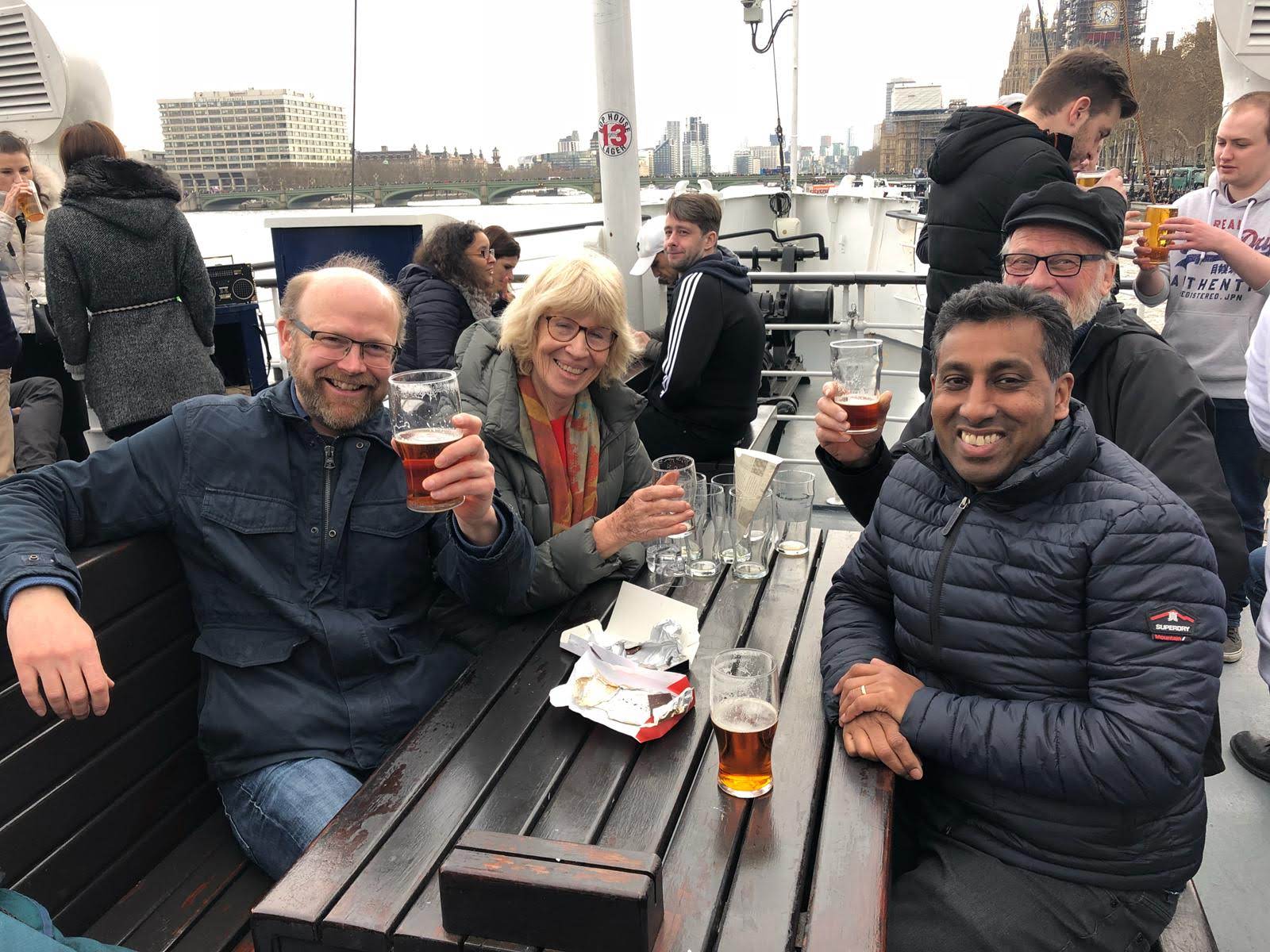
     The poster on the right has to have my prize; others slogans I particularly appreciated were '50%English, 50%Irish, 100%European' and 'This is what a real demo looks like, Nigel!' Things did get claustrophobic as we approached Parliament Square, with a steady flow of people arriving and nowhere to go. A counter flow developed, which we  joined, escaping off to the first promising watering hole that we could find, which happened to be the floating pub on the Tattershall Castle. Even on an old boat permanently tied up in the middle of London, I feel a little better afloat, and I love to watch the tide pulsing in and out regardless of our passing cares!


With Liz and Bernie
So it went on; next day Cristiona, Joe and myself took a boat downriver to Greenwich, which was mobbed with Sunday strollers in fine Spring sunshine that had finally prevailed over grey cloud. London looked magnificent from the hill there, as it did from the river. It's a pity there's no view to the east and the sea though. Of course I would liked to have carried on downriver, towards the place of my birth and earliest memories, Southend-on-Sea. I always however despised those endless mud-flats, that dirty water and the dreary, battered waste-land ashore. How my heart lifted when, in my father's little boat, I first experienced the Atlantic swell down off the Lizard! However,  possibly now, with for instance old rubbish tips reclaimed as nature reserves, with a better appreciation for all those little reminders of a long past and also battered as I am with perhaps too much familiarity with Atlantic swells, I might appreciate the Essex mud-flats better.

     The question is, did the Demo really make a difference, other than leaving us with the agreeable sensation of having done our bit? Where do we go from here? I always tend to revert to seeing the whole problem in terms of fishing, being what I have a lot of first-hand experience of and also because I regard is as a specially good lens through which to view these things. Besides, being on the London River reminded me of Mr Farage's little jaunt on a fishing boat here: a typical meaningless stunt, considering that the inshore fleet has nothing to gain from Brexit, and indeed quite a lot to lose. They mostly deal in shellfish for which the biggest and best market is on the Continent.

     What about bigger boats? It is of course true that the quota system of the CFP is extremely deficient, but who is to say that a national fishing policy would be any better? Either way, it needs a drastic overhaul. We have a classic breakdown between a Command and Control superstructure and actual reality; but one thing Brexit will certainly not produce is more fish. In the case of the Newlyn netter fleet, they will get an awful shock if they lose half their fishing ground, being shut out of Irish waters. But there are very few skipper/owners left, and the health of the stocks is dire. 

      Fishermen are adept at finding new possibilities, and there has indeed anyway been a reduction in effort which presumably has to do some good; however, one should not necessarily take little bits of good news at face value. For example it is very doubtful that the recent good landings of hake off the south of Ireland are merely the result of a decline in Spanish fishing effort and improvement in stocks. More likely it is because, equipped with Olex chartplotters, they have now a very accurate picture of the sea-bed beneath them, and have learnt to target the hake more effectively.

     Anyway most of the British fleet, other than the inshore boats, are company owned. The capital involved could just as well be from Spaniards as anyone else. The quota system does work half well for these companies. In England they are able to buy up and manipulate fish quota in a way that is impossible for a skipper/owner, say in Ireland. Since it became frequently impossible for the Irish skipper to make a living within his quotas, selling fish at public auctions has pretty much died out, for the simple reason that it is not possible to lay out one's catch on the auction hall floor. What the log-books say and what the boxes actually contain are two different things. Meanwhile, the companies are in a better position to negotiate a modus vivendi with the authorities, and when this does break down, they can afford the odd fine in a way the skipper/owner probably cannot. Unless they  are seriously enlightened, they will find it very hard to resist the Duckie's (Trumpian) approach.

     Changing all this will be very difficult. In the extremely unlikely event of a British Government, especially a Tory one, seriously wanting to do so, the fact is that any solution will have a large market dimension, and the market is continent-wide. It will also require the active collaboration of the fishermen themselves and all stake-holders. However the fact that decision-making is perhaps more objective on an EU level, and its very remoteness means it may be less subject to local interests, has its advantages. Certainly nothing can be done when competing national interests constantly subvert and drag down to a lowest common denominator. The necessary scientific and technical know-how are also much more likely to emerge on a continental basis, along with the whole cultural revolution that is called for. 

     To develop the will and indeed the techniques to turn situations like this around is the vital task ahead of us all, if we do not want to bequeath an utterly dysfunctional and dystopic world, where pockets of elite interest scrap over the plundered and degraded remnants of a once beautiful and bountiful world. The EU can only survive and prosper, and ourselves with it, to the degree that it offers a credible context and environment for so doing.


Heading Down the London River.


Tuesday, 19 March 2019

One Last Heave....

One last heave, and we can bury Brexit! I am in London, to be close to the action this coming Saturday. My understanding is that as a serious proposition, if it ever was one, Brexit is dead. The die-hards are merely holding out in the hope that they may get their way on account of the pusillanimity or plain laziness of Europeans. We must now see them off, and a massive demo on Saturday is just the ticket.
One Kind of Transition!


     However, the essential contest at this stage is not so much between Brexiteers and Remainers, but rather between those desperate to get back to 'normality', whose dominant instinct is to avoid rocking the boat too much and to uphold the great British tradition of fudging difficult issues, and on the other hand those who realise that in these increasingly desperate times, issues must be faced and truths upheld. We cannot afford to carry on washing our hands with 'Truth, what is that?'

     Pontius Pilate's line with regard to Brexit goes something like this:- It has all gone on far too long. We did have that vote and cannot  simply ignore it, or we shall never get the country to pull together again; at the same time anyone with a modicum of sense is now aware that our involvement with Europe is far too broad and deep to be simply cut off. We've had a good circus, now let's concentrate on the bread as best we can!

     So what about this dangerous, idealistic notion about truths that must be upheld? What might I have in mind? To put it as simply as I can - there is a nexus of interrelated issues, from climate change and environmental degradation to the structure of wealth, which must be addressed with the utmost urgency, and the European project represents a step in this direction, a basic prerequisite for addressing these issues effectively, which must not be allowed to fail.

     Certainly, the EU has a long way to go, but what sort of an attitude is it that  represents this as a reason to opt out of the whole undertaking? It's not as if we haven't been provided with a clear personification of the alternative, whom one would like to think of as a kind of comic cardboard cut-out if he hadn't got so far, and who is openly contemptuous of the planet and its peoples, while committed to extracting as much wealth as possible on behalf of a small elite with no heed for the cost. It is an alternative which is much more present than we would have expected or have liked to think!

     In marching for an 'Open Britain' this Saturday, I for one will also be marching for the future of my grandchildren in every sense. Now is the time to combine the energies of all those determined to play their part as best they can in the Great Transition to a more just and sustainable future, a future of cooperation rather than competition, of peace rather than war, of hope rather than despair.

     If you cannot march, you might consider making a contribution to the People's Vote crowdfunding. It is hardly necessary at this stage to reiterate the reasons why Mrs May's idea that 'the People's Will' must be implemented, regardless of what they now think after the billions of words that have been uttered and the political chaos that has ensued since the 2016 referendum, is absurd. However, for a good paper on the way ahead, see:- 
 https://www.peoples-vote.uk/how_it_could_happen